Introduction to RAG and the CRAG Architecture
What is RAG?
In today's digital landscape, where information is growing explosively, we often face the challenge of obtaining precise and context-relevant answers to our questions. Conventional generative AI models, such as large language models (LLMs), are impressive in their ability to produce coherent text, yet they often struggle to access specific or current information that was not included in their training data. This is exactly where Retrieval Augmented Generation (RAG) comes into play.
RAG is a powerful framework that combines the strengths of information retrieval and text generation. Essentially, RAG works by retrieving relevant information from a knowledge base before generating an answer. This retrieved information is then provided to the generative model as context, enabling it to deliver more precise, well-founded, and up-to-date answers. This significantly reduces the likelihood of "hallucinations" (generated false information) and greatly improves the relevance of the output.
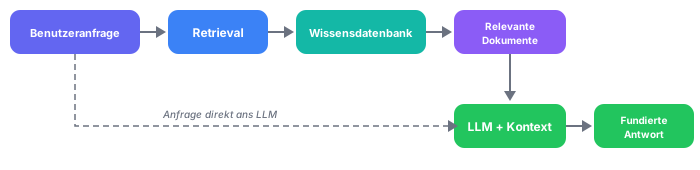
Overview of CRAG: The Architecture of Your System
Your Conversational Retrieval Augmented Generation (CRAG) system is built in a modular fashion and designed to be flexible and scalable. It uses Docker and Docker Compose to run individual components in isolated containers, which significantly simplifies development, deployment, and maintenance.

The main components of your CRAG system include:
-
Frontend (User Interface): This is the interface through which you and other users interact. It is a lean, web-based application (HTML/JavaScript) that accepts user queries and displays the generated answers. Access is provided through an Nginx web server, which also serves as a reverse proxy for the backend.
-
Backend (API Logic): The heart of the system. A FastAPI application in Python responsible for processing user queries. The backend orchestrates the entire RAG process: it receives queries from the frontend, retrieves relevant documents from the knowledge base, and passes them along with the user question to a large language model (LLM) for answer generation.
-
Data Preprocessing (Ingestion Pipeline): A separate service responsible for reading, parsing, and preparing source documents (e.g., PDFs). This service extracts text, splits it into smaller sections (chunks), generates vector embeddings for these chunks, and then indexes them in the knowledge base.
-
OpenSearch (Document and Vector Storage and Search): This is the central database for your knowledge base.
- OpenSearch: An open-source search and analytics engine based on Elasticsearch. You use it to store text chunks and to perform keyword-based as well as vector-based similarity searches. OpenSearch thus serves as your single database for both search types.
-
Additional Services:
- MinIO: An open-source object storage service with S3 compatibility. You use it to store raw documents (e.g., PDFs of your Kafka book) before they are processed.
Advantages of the Modular and Containerized Architecture:
Choosing a modular and containerized architecture with Docker and Docker Compose offers you several decisive advantages:
-
Isolation: Each component runs in its own container, which avoids conflicts between dependencies and increases the stability of the overall system.
-
Portability: The entire application can be run on any platform that supports Docker, regardless of the underlying operating system.
-
Scalability: Individual services can be scaled independently as needed to handle higher loads.
-
Easy Development: You can focus on implementing one component without worrying about the configuration of other services.
-
Simplified Deployment: Docker Compose allows you to define and start all services with a single command, significantly accelerating and simplifying deployment.
Planning a RAG system for your domain content? Contact me for a no-obligation consultation on architecture and implementation.