
Agentic RAG: The Next Evolution of Intelligent Systems

Photo by Gabriele Malaspina on Unsplash
Since the introduction of RAG (Retrieval Augmented Generation) in 2020, the technology has become the standard for knowledge-based AI applications. However, classical RAG systems quickly reach their limits when dealing with complex queries.
Agentic RAG represents the next evolutionary step: systems that not only retrieve information and generate answers, but autonomously plan, reflect, and work iteratively — like a human researcher.
The Problem with Classical RAG
The Linear Approach
Classical RAG systems follow a rigid pipeline pattern:

This pattern works well for simple factual questions ("When was the company founded?"), but fails with:
- Multi-part questions: "Compare our Q3 figures with the previous year and explain the deviations"
- Questions with implicit knowledge: "What impact does the new EU regulation have on our product?"
- Synthesis tasks: "Create a summary of all customer complaints about Feature X"
The Fundamental Limitations
- Single-Shot Retrieval: One search query, no opportunity for refinement
- No Quality Control: The system doesn't know whether the retrieved documents are relevant
- No Decomposition: Complex questions are not broken down into sub-problems
- No Context Building: Each query stands in isolation, no iterative knowledge building
What Makes an Agent?
An agent differs from a simple LLM through four core capabilities:
1. Planning
The agent analyzes a task and breaks it down into executable steps:
Task: "Analyze the performance of our top 5 products"

Agent Plan:
1. Identify the top 5 products by revenue
2. Retrieve sales data for each product
3. Calculate growth rates
4. Identify trends and anomalies
5. Synthesize findings into an analysis
2. Tool Use
Agents can employ various tools:
| Tool | Purpose | Example |
|---|---|---|
| Vector Search | Semantic document search | "Find documents about customer service" |
| SQL Query | Structured data retrieval | "SELECT * FROM sales WHERE..." |
| Web Search | Current external information | "Current EUR/USD exchange rate" |
| Calculator | Mathematical operations | "Calculate 15% of 2.5M" |
| Code Execution | Data analysis, visualization | "Create a chart of the data" |
3. Reflection
After each step, the agent evaluates its approach:
- Is the retrieved information relevant?
- Are important aspects still missing?
- Do sources contradict each other?
- Is the answer quality sufficient?
4. Iteration
Based on reflection, the agent can:
- Launch additional search queries
- Adjust the plan
- Deploy additional tools
- Refine the answer
The ReAct Pattern
The ReAct Pattern (Reasoning + Acting) is the dominant paradigm for agent-based systems. It structures agent behavior into an explicit cycle:

Example of a ReAct Run
Question: "How did our market share in the DACH region develop in 2024?"
Thought 1: I first need to find our current market share data.
           I'll search the internal database for this.

Action 1:  vector_search("market share DACH 2024")

Observation 1: Found: Q3 report with 23% market share, Q1 report with 21%

Thought 2: I have Q1 and Q3 data. For a complete analysis,
           I also need Q2 and Q4 as well as prior year data.

Action 2:  vector_search("market share Germany Austria Switzerland Q2 Q4 2023 2024")

Observation 2: Found: Annual report 2023 (19% market share), Q2-2024 (22%), Q4-2024 (24%)

Thought 3: Now I have all the data. Market share rose from 19% (2023)
           to 24% (Q4 2024), a growth of 5 percentage points.
           I can now provide a well-founded answer.

Final Answer: Market share in the DACH region developed very positively in 2024.
              Starting from 19% at the end of 2023, it rose continuously to 24% in Q4 2024...
Architecture of an Agentic RAG System
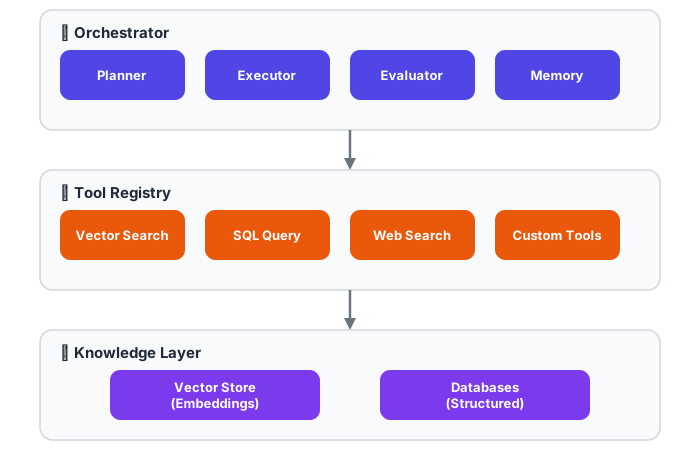
Component Overview
The Orchestrator
The orchestrator is the "brain" of the system with four main modules:
Planner: Breaks down complex tasks into sub-steps and creates an execution plan.
Executor: Carries out the planned actions and coordinates tool calls.
Evaluator: Assesses the quality of results and decides on further steps.
Memory: Stores the conversation context and enables long-term recall.
Tool Registry
The Tool Registry manages all available tools. Each tool is described by a schema:
- Name: Unique identifier
- Description: When and what the tool should be used for
- Parameters: Expected inputs with types and descriptions
- Return Value: Output format
These schemas enable the LLM to select the right tool for each situation.
Self-Reflection: The Key to Quality
A critical difference from classical systems is the ability for self-reflection.
Reflection Dimensions
| Dimension | Check | On Failure |
|---|---|---|
| Relevance | Do the documents answer the question? | New search with different keywords |
| Completeness | Are all aspects covered? | Ask additional sub-questions |
| Consistency | Do sources contradict each other? | Prioritize primary sources |
| Timeliness | Is the data current enough? | Apply time filters |
| Confidence | How certain is the answer? | Communicate uncertainty |
Hallucination Prevention
Agentic RAG reduces hallucinations through:
- Source Anchoring: Every statement is linked to a source
- Fact Checking: Critical statements are validated against multiple sources
- Uncertainty Communication: The system admits when it doesn't know something
- Iterative Refinement: When in doubt, additional sources are consulted
Use Cases
1. Enterprise Knowledge Management
Scenario: An employee asks: "What are our remote work policies in different countries?"
Classical RAG: May only find the general remote work policy.
Agentic RAG:
- Identifies all relevant country-specific policies
- Searches for country-specific regulations
- Checks for timeliness (latest changes)
- Synthesizes a cross-country overview
- Highlights differences and special considerations
2. Technical Support
Scenario: "My API is returning error 503, what can I do?"
Agentic RAG:
- Searches for documentation on error 503
- Checks known issues in the knowledge base
- Searches for similar support tickets
- Optionally queries the system status API
- Creates a step-by-step troubleshooting guide
3. Research & Analysis
Scenario: "Create a competitive analysis for our new product"
Agentic RAG:
- Identifies relevant competitors
- Gathers information on each competitor
- Searches internal market research
- Optionally conducts web research
- Structures findings in SWOT format
- Identifies differentiation potential
Best Practices for Implementation
1. Tool Design
Good tools have:
- Clear Descriptions: The LLM must understand when each tool is useful
- Clear Boundaries: Avoid overlapping functionalities
- Robust Error Handling: Graceful degradation on failures
- Consistent Output Formats: Structured, parsable results
2. Iteration Limits
Set clear boundaries:
- Maximum number of tool calls (e.g., 10)
- Timeout for overall execution
- Budget for API calls to external services
3. Observability
Log every step:
- Which tools were called?
- What decisions did the agent make?
- How long did each step take?
- What costs were incurred?
4. Guardrails
Implement safety mechanisms:
- Input validation for all tool parameters
- Output filtering for sensitive data
- Authorization checks per tool
- Rate limiting for external APIs
Challenges and Limitations
Latency
Agentic RAG is slower than classical RAG:
- Multiple LLM calls instead of one
- Sequential tool execution
- Reflection overhead
Mitigation: Parallelization where possible, caching, streaming responses
Costs
More LLM calls = higher costs:
- Each reasoning step costs tokens
- Tool descriptions increase the context size
Mitigation: Efficient prompt engineering, smaller models for simple decisions
Debugging Complexity
Non-deterministic execution paths make debugging difficult.
Mitigation: Comprehensive logging, reproducible seeds, trace visualization
Outlook: Multi-Agent Systems
The next evolutionary step is multi-agent systems, where specialized agents collaborate:
- Research Agent: Specialized in information gathering
- Analysis Agent: Focused on data evaluation
- Writing Agent: Creates structured reports
- Review Agent: Reviews and improves results
These agents communicate, delegate tasks, and combine their strengths.
Conclusion
Agentic RAG transforms passive retrieval systems into active problem solvers. Through the combination of planning, tool use, reflection, and iteration, these systems can tackle complex knowledge tasks that remain beyond the reach of classical approaches.
Implementation requires careful design, but the results justify the effort: higher answer quality, better traceability, and the ability to truly answer complex questions.
Would you like to implement an Agentic RAG system for your organization? Contact me for a no-obligation consultation.